The 100 Best Lifehack Articles You Might Have Missed in 2013
Slumber deprivation is pretty common these days—information technology's a major aspect of achievement-oriented societies—but why would anyone take a dearest-hate relationship with it? Ordinarily, one would say,sleep deprivation and all the accompanying symptomsare the definition of a love-hate human relationship, to the core.
Let me tell you something: y'all canuse sleep deprivation for your own benefit. Nosotros'll get into how this works, merely first, let's discuss the miracle of slumber, sleep deprivation and its symptoms, and finally pattern a "how to" experiment about sleep deprivation(usually known as self-torture), and ask ourselves, more than importantly, why?
Slumber: Functionality
"Sleep is a naturally recurring land characterized by reduced or absent consciousness, […] and inactivity of nearly all voluntary muscles." (Macmillan, 1981). This is a short and clear explanation:
- slumber is characterized by slumber stages/cycles (5 cycles, differing in depth)
- the deeper your sleep, the ameliorate the quality of sleep
- More Slumber ≠ Better (healthy avg. 7.5-nine hours)
The functions of sleep are very multifaceted and majorly unexplored, but these (validated, and unremarkably accepted) aspects interest united states the about correct now. Sleep has a major affect:
- on our retention and the ability to re-organize thoughts, experiences and to learn new things (neuroplasticity)
- on the regulation of necessary hormones and the ability of our body to regenerate physically
What is Sleep Deprivation?
Sleep deprivation is the lack of sleep: either information technology was caused by a very superficial and short sleep (over a menstruation of some days) or by no sleep at all. The functionality and benefits of sleep are limited equally a result (run across to a higher place), and we might face someserious bug, if nosotros stay sleep-deprived for a prolonged menstruation of time.
The effects of sleep deprivation are various; some occur instantly afteracute deprivation, other occur only subsequentlychronic deprivation:
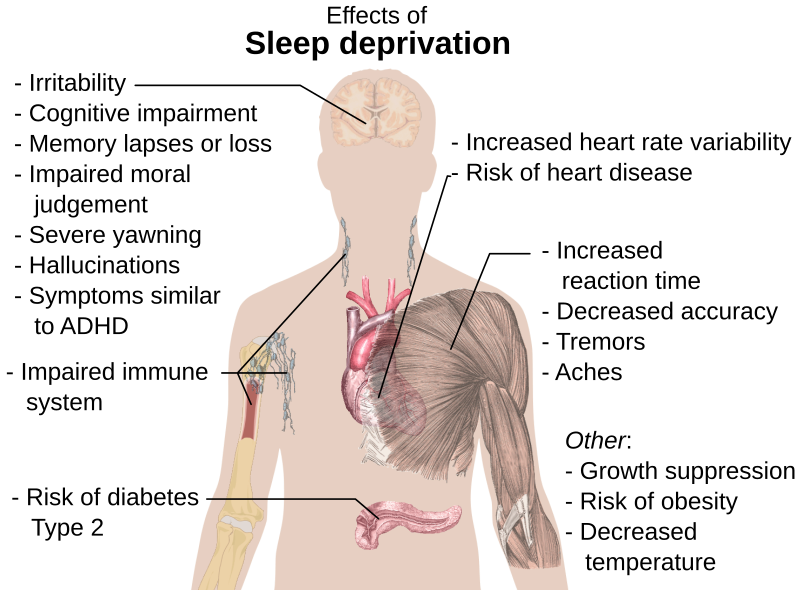
(by Mikael Häggström, Wikimedia Eatables, 2009)
After astute deprivation:
- irritability
- cognitive damage
- memory lapses
- restricted sentence
- severe yawning
- increased heart-charge per unit variability, increased reaction time and decreased accuracy
- temporary emotional instability
After chronic deprivation:
The effects of chronic deprivation boil downward to the development of diverse diseases, such every bit:
- Diabetes
- center illness
- growth suppression
- restricted immune system functionality
- weight gain/loss
- low
Due to the variety of astute deficits, sleep impecuniousness has been used equally a successful interrogation technique. In fact, the U.Southward. military authorised slumber deprivation as an interrogation method (Leave no Marks: Enhanced Interrogation Techniques and the Chance of Misdeed, August 2007).
But hey, why would there exist alove-detest human relationship here? What'southward the do good for united states of america?!
How To (..and the benefits of slumber deprivation?!)
The effects of slumber impecuniousness on the human being body were observed and analyzed in the 70s: the methodological monitoring involved blood analysis, but also neuropsychological instruments to capture the brain activity during sleep-deprivation and duringrecovery sleep subsequently deprivation.
The results:"There'south evidence of antidepressive effect after slumber deprivation."As a thing of fact, subjects experienced a37.2 % improvement in their mood!
The background of these results are diverse—the reasons behind the remarkable mood comeback are, amongst others:
- biochemical investigations proved an increase of dissimilar hormones, including serotonin and noradrenaline, which are too known to functionevery bit a happiness hormone (serotonin) and stimulating hormone (noradrenaline)
- improved sleep continuity and depth in the nighttime after slumber deprivation
These mentioned effects take activeness in depressedmerely also not-depressed people,meaning that you can stay awake for a nighttime, begin the adjacent day as you usually do and endeavour to keep yourself awake (that's non very easy!) and go to bed quite early on → slumber like a baby → wake up the adjacent morning withmore power and energy.
By depriving yourself of sleep, youfix your biological clock to null— in example your fourth dimension management is messed up and running out of fuel, this can very helpful (a love-detest human relationship). Y'all can call sleep deprivationslumberhacking: at get-go we abstain from slumber, and subsequently (during the recovery night) we slip into a very deep country of sleep, which will regenerate us.
Admittedly, sleep impecuniousness amongst healthy people is often met with skepticism, mainly because healthy subjects tin regulate their slumber pattern in other ways (through nutrition, sleep hygiene and sleep rituals). On the other manus, sleep deprivation is gratuitous of any serious side effects and tin can serve as a quick fix. Hither's a short how-to:
- Perform your sleep deprivation "experiment" on the weekend (working in a sleep deprived state tin can exist difficult)
- Keep yourself awake during your sleep deprivation night (and the post-obit day) with the assist of tea or coffee, simply please don't overdo it
- Go to bed early on your sleep-deprived day, and savour your deep recovery night (7.five – ix hours)
- Wake up powerful and energized, feeling like a million dollars
After your sleep deprivation experiment you should accept care of a well-balanced diet and good sleeping habits—do not regress to onetime, negative tendencies. Sleep deprivation for a night can exist applied easily, is highly effective and free of serious side effects. Accept you already tried it? Share your feel with united states of america!
Featured photo credit: Lux Graves via unsplash.com
Source: https://www.lifehack.org/articles/lifestyle/the-100-best-lifehacks-2013-the-year-review.html
0 Response to "The 100 Best Lifehack Articles You Might Have Missed in 2013"
Postar um comentário