In Comparing the Family Roles of Black and White Women, It May Be Observed That Black Women:

The Sapphire Extravaganza portrays black women as rude, loud, malicious, stubborn, and overbearing.i This is the Aroused Blackness Woman (ABW) popularized in the cinema and on telly. She is tart-tongued and emasculating, one hand on a hip and the other pointing and jabbing (or arms akimbo), violently and rhythmically rocking her head, mocking African American men for offenses ranging from beingness unemployed to sexually pursuing white women. She is a shrill nagger with irrational states of anger and indignation and is frequently mean-spirited and abusive. Although African American men are her primary targets, she has venom for anyone who insults or disrespects her. The Sapphire'south desire to dominate and her hyper-sensitivity to injustices make her a perpetual complainer, merely she does non criticize to improve things; rather, she criticizes considering she is unendingly bitter and wishes that unhappiness on others. The Sapphire Caricature is a harsh portrayal of African American women, but it is more than that; it is a social control machinery that is employed to punish black women who violate the societal norms that encourage them to be passive, servile, non-threatening, and unseen.
Sapphire Stevens
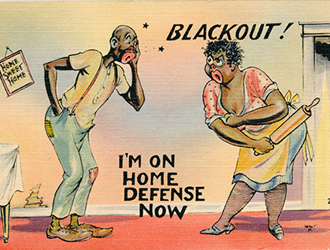
From the 1800s through the mid-1900s, black women were often portrayed in popular culture as "Sassy Mammies" who ran their ain homes with fe fists, including berating blackness husbands and children. These women were allowed, at least symbolically, to defy some racial norms. During the Jim Crow period, when existent blacks were oftentimes beaten, jailed, or killed for arguing with whites, fictional Mammies were immune to pretend-chastise whites, including men. Their sassiness was supposed to indicate that they were accustomed as members of the white family, and credence of that sassiness implied that slavery and segregation were not overly oppressive. A well-known example of a Sassy Mammy was Hattie McDaniel, a black actress who played feisty, choleric mammies in many movies, including Judge Priest (Wurtzel & Ford, 1934), Music is Magic (Stone & Marshall, 1935), The Little Colonel (DeSylva & Butler, 1935), Alice Adams (Berman & Stevens, 1935), Saratoga (Hyman & Conway, 1937), The Mad Miss Manton (Wolfson & Jason, 1938), and Gone With the Wind (Selznick & Fleming, 1939). In these roles she was sassy (borderline impertinent) but always loyal. She was not a threat to the existing social lodge.
It was not until the Amos 'n' Andy radio testify that the characterization of African American women as domineering, aggressive, and emasculating shrews became popularly associated with the proper name Sapphire. The show was conceived by Freeman Gosden and Charles Correll, two white actors who portrayed the characters Amos Jones and Andy Chocolate-brown past mimicking and mocking black behavior and dialect. At its best, Amos 'due north' Andy was a situational comedy; at its worse, it was an auditory minstrel show.ii The show, with a mostly-white cast, aired on the radio from 1928 to 1960, with intermittent interruptions. The television version of the show, with network tv's kickoff all-black bandage, aired on CBS from 1951-53, with syndicated reruns from 1954 to 1966. It was removed, in large office, through the efforts of the National Clan for the Advancement of Colored People and the civil rights motility. Both as a radio show3 and television show, Amos 'n' Andy was extremely popular, and this was unfortunate for African Americans because it popularized racial caricatures of blacks. Americans learned that blacks were comical, non as actors just as a race.
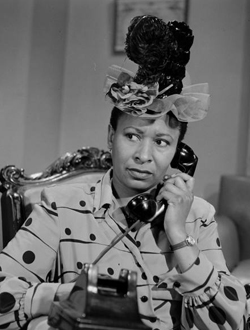
Amos 'northward Andytold stories about the everyday foibles of the members of the Mystic Knights of the Sea, a blackness fraternal gild. The lead characters were Amos Jones, a Harlem taxi driver and his gullible friend, Andy Brown. Starring in a nontitle pb role was the character George "Kingfish" Stevens, the leader of the guild. Many of the stories revolved around Kingfish, a go-rich-quick schemer and a con creative person who avoided piece of work, and, when possible, took financial advantage of the ignorance and naivete of Andy and others (run across, for example, the episode Kingfish Sells a Lot). Kingfish was the prototypical Coon, a lazy, easily confused, chronically unemployed, financially inept buffoon given to malapropisms. Kingfish was married to Sapphire Stevens who regularly berated him every bit a failure.
Kingfish represented the worst in racial stereotyping; there was picayune redemptive about the character. His ignorance was highlighted by his nonsensical misuse of words, for example, ""I deny the allegation, Your Honor, and I resents the alligator," or "I'se regusted." Kingfish was not a good thinker or speaker. Fifty-fifty worse, he was a crook without scruples. He was too lazy to work and not above exploiting his wife and friends.
In other words, he was a television embodiment of some of the unforgiving ideas that many Americans had nigh black men. Other characters, including Lightnin,' a Stepin Fetchit-like character on the show, had jobs and were honest, merely Kingfish'south worthlessness justified Sapphire's harsh critique of his life. It must be noted, that Sapphire Stevens directed her cloy at her husband; hers was not the generalized anger that is today associated with angry black women.
Later on Sapphires in Situational Comedies
Sue Jewell (1993), a sociologist, opined that the Sapphire image necessitates the presence of an African American man; "It is the African American male person that represents the point of contention, in an ongoing exact dual between Sapphire and the African American male ... (His) lack of integrity and use of cunning and trickery provides her with an opportunity to emasculate him through her use of exact put downs" (p. 45). In the all-blackness or mostly-blackness situational comedies that take appeared on television from the 1970s to the present, the Sapphire is a stock character. Like Sapphire Stevens, she demeans and belittles lazy, ignorant, or otherwise flawed black male person characters.
Blacks on boob tube have been overrepresented in situational comedies and underrepresented in dramatic series; ane problem with this imbalance is that blacks in situational comedies are portrayed in racially stereotypical ways in social club to get laughs. Canned laughter prompts the television audience to laugh every bit the angry black woman, the Sapphire, insults and mocks blackness males.
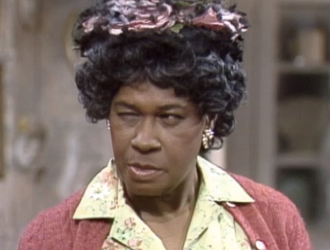
Aunt Esther (also called Aunt Anderson) was a Sapphire character on the television situational one-act Sanford and Son, which premiered on NBC in 1972, with a last episode in 1977, and is still running in syndication. She was the Bible-swinging, angry nemesis and sister-in-law of the main character, Fred. Theirs was a beloved-by and large hate human relationship. Fred would call Aunt Esther ugly and she would call him a "fish-eyed fool," an "old sucka," or a "beady-eyed heathen." Then, they would threaten to hit each other. Aunt Esther dominated her married man Woodrow, a balmy-mannered alcoholic. In this latter relationship, you have the thought of the aggressive black woman dominating a weak, morally defective blackness man.
The situational comedy Proficient Times aired between 1974 and 1979 on the CBS television receiver network. The show followed the life of the Evans family in a Chicago housing project modeled on the infamous Cabrini-Green projects. This was one of the beginning times that a poor family had been highlighted in a weekly television series. Episodes of Expert Times dealt with the Evans' attempts to survive despite living in suffocating poverty. There were several racial caricatures on the show, near notably the son, James Evans Jr. (as well chosen J.J.), who devolved into a Coon-like minstrel. After the first season the episodes increasingly focused on J.J.'s stereotypically buffoonish behavior. Esther Rolle, the actress who played the role of Florida Evans, the mother, expressed her dislike for J.J.'s character in a 1975 interview with Ebony magazine: "He's eighteen and he doesn't work. He tin't read or write. He doesn't recollect. The evidence didn't start out to exist that...Piddling by little-with the help of the artist, I suppose, because they couldn't do that to me -- they take fabricated J.J. more stupid and enlarged the part. Negative images have been slipped in on us through the character of the oldest child."("Bad Times" 1975) In black-themed situational comedies when there is a Coon graphic symbol there is often a Sapphire character to mock him. In Practiced Times a character that bantered with and mocked J.J. was his sis, Thelma. A clearer case of a Sapphire, still, was the neighbor, Willona Woods, though she rarely targeted J.J. Instead, Willona belittled Nathan Bookman, the overweight superintendent, and she put downward a series of worthless boyfriends, an ex-hubby, politicians, and other men with questionable morals and work ethics.
In situational comedies with a primarily black cast, the black male does not have to be lazy, thick-witted, or financially unsuccessful for him to exist taunted by a Sapphire grapheme. The Jeffersons, which aired from 1975 to 1985, focused on an upper-middle class family that had climbed up from the working class -- in the show's theme vocal there is the line, "We finally got a slice of the pie." George and Louise Jefferson were making and so much money from their dry out-cleaning businesses that they hired a housekeeper, Florence Johnston. Her relationship with George was often antagonistic and the back-talking, wisecracking, housekeeper approximated a Sapphire. She often teased George about his short stature, balding head, and decisions.
Another case of a Sapphire was the character Pamela (Pam) James, who appeared on Martin, a situational comedy that aired from 1992 to 1997 on Fox. Pam was a badmouthed, wisecracking friend/foe of the pb grapheme, Martin. Tichina Arnold, the actress who played Pam, plays Rochelle, a dominating, aggressive dame in the situational one-act, Everybody Hates Chris, which ran from 2005 to 2009, and is still aired on cable television. Arnold has mastered the part of the angry, black adult female.
Angry Black Women with Guns
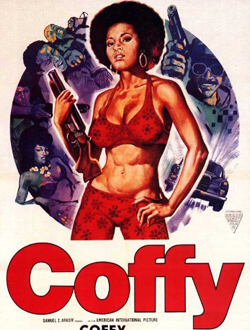
The pic genre called blaxploitation emerged in the early 1970s. These movies, which targeted urban blackness audiences, exchanged ane set of racial caricatures -- Mammy, Tom, Uncle, Picanninny -- for a new ready of equally offensive racial caricatures -- Bucks (sex-crazed deviants) Brutes, (pimps, striking-men, and dope peddlers), and Nats (Whites-haters). One one-time caricature, the Jezebel, was revamped. The portrayal of African American women as hyper-sexual temptresses was as old every bit American slavery, merely during the blaxploitation period the Jezebel caricature and the Sapphire caricature merged into a hybrid: aroused "whores" fighting injustice. Black actresses such as Pam Grier built careers starring in blaxploitation movies. Their characters resembled those of the black male superheroes: they were physically attractive and aggressive rebels, willing and able to use their bodies, brains, and guns to proceeds revenge against decadent officials, drug dealers, and violent criminals. Their anger was not focused solely, or primarily, at blackness men; rather, information technology was focused at injustice and the perpetuators of injustice.
In the picture Coffy (Papazian & Hill, 1973), Pam Grier (Coffy) plays a nurse by twenty-four hour period and vigilante by night who conducts a savage one-woman war on organized crime. In the movie, she pretends to be a "strung out whore" to become revenge on the drug dealers who got her trivial sister hooked on heroin. Coffy lures the culprits dorsum to their room where she graphically shoots i in the head and gives the other a fatal dose of heroin. The residue of the movie finds Coffy using guns and her body to punish Rex George, a flamboyant pimp, the sadistic mobster Arturo Vitroni, and every Mafioso and crooked cop who crosses her path.
Sapphire in the 21st Century
Today, the Sapphire is i of the dominant portrayals of black woman. This is axiomatic by the words of Cal Thomas, a commentator for FOX Tv set: "Look at the epitome of angry black women on telly. Politically you have Maxine Waters of California, liberal Democrat. She's always angry every fourth dimension she gets on boob tube. Cynthia McKinney, another aroused black adult female. And who are the black women you come across on the local news at night in cities all over the land. They're ordinarily angry about something. They've had a son who has been shot in a drive-by shooting. They are angry at Bush. So y'all don't really have a profile of not-angry black women, of whom at that place are quite a few."("Transcript: Fox", 2008) Thomas, admittedly an untrained sociologist, expressed what many Americans see and internalize, namely, images of Sapphires: angry at black men, white men, white women, the federal regime, racism, maybe life itself. Thomas, presently later on making his statements about blackness women, agreed with a co-panelist that Oprah Winfrey is non aroused.
The portrayal of black women as angry Sapphires permeates this culture. A Google search of Angry Black Women or ABW will demonstrate how pervasive this caricature has go. She lives in most movies with an all-blackness or predominantly black cast. For example, there is Terri, cussing and insulting the "manhood" of black men in Barbershop (Chocolate-brown, Teitel, Tillman & Story, 2002) and its sequel, Barbershop 2 (Gartner, Teitel, Tillman & Sullivan, 2004). At that place is the augmentative Angela in Why Did I Get Married (Cannon & Perry, 2007). There is clip art of an angry black woman at www.clipartof.com/details/clipart/16467.html. The clip fine art description reads, "Royalty-free people clipart picture image of an angry african american woman in a purple apparel and heels, standing with her arms crossed and borer her foot with a stern expression on her confront. She could be mad at her child, a colleague or married man." There are stock pictures of aroused black women, such every bit those at www.inmagine.com/bld108/bld108498-photo. In that location are books devoted to angry black women, for example, The Angry Black Adult female's Guide to Life (Millner, Burt-Murray, & Miller, 2004), and Web sites such every bit http://angryblackbitch.blogspot.com/where you can purchase Aroused Blackness Bitch cups, shirts, pillows, tile coasters, aprons, mouse pads, and Teddy Bears. There is even a pseudo-malady chosen, "Angry Black Woman Syndrome."
The tabloid talk shows that became pop in the 1990s: The Jerry Springer Bear witness, The Jenny Jones Show, The Maury Povich Show, and The Ricki Lake Show, helped reinforce the racial stereotypes of African Americans, including the stereotype of black women as angry, castrating shrews. By the early 2000s, the "Trash Talk" shows had receded in popularity, in part because of the emergence of so-called "Reality Shows." Once again, these shows served equally vehicles for African American women to exist portrayed as Sapphires. Vanessa E. Jones, from the Boston Globe, wrote of the Sapphire: "You run across elements of her in Alicia Calaway of "Survivor: All-Stars," who indulged in a temperamental bout of finger wagging during an argument in 2001'south "Survivor: The Australian Outback." Coral Smith, who rules with an atomic number 26 tongue on MTV's "Real Earth/Road Rules Claiming: The Inferno," browbeat one female bandage mate and then desperately a week agone that she challenged Smith to a fight. Then there'south Omarosa Manigault-Stallworth of "The Apprentice," who rode the angry-black-woman stereotype to the covers of People and TV Guide magazines even equally she made boyfriend African-American businesswomen wince."(Jones, 2004) Omarosa Manigault-Stallworth gained a cracking deal of national disdain and glory as a contestant on The Apprentice, Donald Trump'due south reality prove. Manigault-Stallworth, who is almost ever referred to by the single proper noun Omarosa, was portrayed (and intentionally acted) every bit a cross betwixt a Jezebel -- a hypersexual flirt and seductress -- and a bitter, aggressive Sapphire. Lorien Olive (2008), a political blogger, theorized on how white people saw Omarosa: "At least among white people, she was interpreted in various ways as conniving, lazy, selfish, a sham, overly-ambitious, uppity, ungrateful, and paranoid. I judge I was e'er less interested in whether Omarosa was really whatever of those things or whether it was merely an effect of the distortion of the editing of reality television. I was more than interested in the fact that Omarosa seemed to stand for something bigger in the eyes of many white people. Her abiding accusations of racism directed toward her fellow contestants and the fact that she wore her alienation and distrust of her team-mates on her sleeve opened up a whole world of racial speculation and ridicule. I would say debate, but in all of my internet travels, I haven't found much of anyone who wanted to go out on a limb for Omarosa. The fact that and so many white people felt justified in their hatred for Omarosa (a hatred that could exist passed of every bit a benign over-investment in a guilty pleasance: a reality Television series) is telling. She became the symbol of everything that went wrong in the post-Ceremonious Rights Era: paranoid "reverse racism"; the ungrateful and undeserving product of affirmative action; the "uppity" Black person who puts on airs; the cute, hyper-sexualized Black adult female who pulled the wool over the powerful white man'southward eyes." Olive next makes a connectedness that many others are making on Internet sites, namely, that Showtime Lady Michelle Obama is the new Omarosa: a bitter, selfish, uppity, ungrateful, overly-aggressive Sapphire. Ane of the cheeky nicknames for Michelle Obama is "Omarosa Obama." This demonstrates how the Sapphire caricature has broadened from an emasculating hater of blackness men to a biting woman who hates anyone who displeases her.
Michele Obama as Sapphire

Sociologists often speak of how dominant groups praise a behavior when done by its members, but criticize a minority group for demonstrating that behavior. To use sociological jargon, this is an example of an in-group virtue becoming an out-group vice. According to the blogger abagond (2008), "Where white women are said to be 'independent,' black women are said to be 'emasculating,' robbing their men of their sense of manhood. Where white women are said to exist standing up for themselves, black women are seen every bit wanting a fight. And so on. The aforementioned actions are read differently." Being an articulate foe of injustice may exist seen every bit a praise-worthy trait amidst whites; still, black women with similar traits may be seen as biting, selfish complainers.
Michelle Obama challenges the scripts that many Americans have for African American women. She is the antithesis of the Mammy caricature. The traditional portrayal of Mammy looked something like this: an obedient, loyal domestic retainer, who cared more for the family members of her employer than she did for her own family; overweight and desexualized; and, most of import to the portrait: not a threat to the social order. Michelle Obama is a Harvard-trained attorney, a conscientious female parent, physically attractive, and she critiques and challenges the culture. She too does not fit the Jezebel paradigm or its mod variant: the barrel-shaking Hoogie Mama -- though FOX News tried to imply this when they referred to her in text equally Senator Obama'south "Baby Mama." Michelle Obama is not a Tragic Mulatto; she is a dark-skinned woman actively involved in civil rights and community activism. The so-called Tragic Mulatto was ashamed of her African heritage; Michelle Obama embraces her African American heritage and expresses her dissatisfaction with racial injustice.
And so, if she does not fit i of the three ascendant historical caricatures of African American women, what imagery is left? Ideally, she would be judged on her individual traits and not as a i-dimensional stereotype; however, there is little ideal about patterns of race relations in this state. Racial stereotyping, too often, is a user-friendly way to pigeonhole others into categories that make sense to us. Instead of allowing Michelle Obama to be central to a new cultural narrative of blackness women (and the black family unit) at that place is a growing tendency to view Michelle Obama's words and behaviors every bit examples of the blackness woman as Sapphire. When she said, while speaking at a Milwaukee, Wisconsin political rally, "for the first time in my adult life I am proud of my land because it feels similar hope is finally making a comeback," she was accused of beingness an unpatriotic, ungrateful, and angry radical. In this portrait, she is more Pam Grier (sans the gun and the hypersexuality) than Sapphire Stevens; her supposed bitterness and hatred are directed toward her country -- and implicitly its white citizens -- and not toward blackness men. Finally, at that place was a label to stick to her. According to Erin Aubry Kaplan (2008), a journalist and blogger:> "It's worth noting how Michelle was admired as long equally she filled the prescription of a successful blackness woman on paper -- college grad, married to an equally successful blackness man, a working but attentive female parent, financially secure, immaculately turned out. But equally shortly as she began revealing herself as a person and airing her views a bit, she began shape-shifting in the public eye into another kind of blackness woman altogether: angry, obstinate, mouthy -- a stereotypical harpy lurking in all black women that a friend of mine calls 'Serpentina.' The consternation about Michelle suggested an old racist sentiment that you tin can take the girl out of the ghetto, only you can never take the ghetto out of the girl." Sean Hannity, Neb O'Reilly, Rush Limbaugh, Laura Ingraham and other bourgeois talkshow hosts rushed to paint her equally the ultimate aroused black adult female, and they wondered aloud what she had to be aroused most. Not all the lambasting came from white Americans. Mychal Massie (2008), chairman of the National Leadership Network of Black Conservatives-Project 21 -- a conservative blackness recall tank, said: "I find information technology reprehensible that those like herself and her husband, existence devoid of credible positions, are able just to arraign America and castigate its citizens. And that is exactly what Michelle Obama did -- with 1 sentence, she attacked every American, regardless of party affiliation when she uttered those profane words...Many Americans contribute to the Obamas' improvident lifestyle. From those who make clean their floors to those who sweep their sidewalks. Her comments reveal ingratitude and were an insult to millions of hardworking Americans and legal immigrants who capeesh the liberty and opportunity America offers. This land has made it possible for Michelle Obama to enjoy every privilege she and her family savour. Compared to the eloquent grace of Jackie Kennedy, Nancy Reagan, Barbara Bush-league and yes, even Rosalind Carter, she portrays herself equally only another angry black harridan who spits in the face of the nation that fabricated her rich, famous and prestigious." Fundamental to these "critiques" of Michelle Obama is the couched argument that a person who is a successful attorney and ambassador living in a dainty home has forfeited the right to talk about injustice and inequality. This statement is short-sighted and flawed. It implies that just poor people accept the correct to express concerns about poverty, only the ill and diseased have a right to complain nigh inadequate wellness care, only a victim of criminal offence has the right to complain about high crime rates, and so forth. The day that the privileged in this country -- and that includes Sean Hannity, Beak O'Reilly, Blitz Limbaugh, Laura Ingraham, Mychal Massie, and Michelle Obama -- are as disgusted with injustice and equality as is the poor black or brown or white single female parent in Detroit, Michigan, is the twenty-four hour period this country takes a living pace toward realizing its potential as the "metropolis on the height of the hill." Critiquing America is non the same as antisocial America.
How does her proverb, "for the first time in my adult life I am proud of my country because it feels like hope is finally making a comeback," validate Massie's merits that Michelle Obama is "another black harridan?" A harridan is a "scolding (even savage) sometime woman" ("Harridan", due north.d.). Calling someone a harridan for expressing an opinion is an ad hominem statement that tries to dismiss the substance of their stance. Members of society who limited unpopular opinions are often dismissed with personal attacks.
Conclusion
Newt Gingrich and the Republican Party rode the anger of white men into political authorisation in 1994. What were they aroused about? Affirmative action? Multiculturalism? Liberalism? Few people, specially members of the ascendant group, questioned whether white men had the correct to be angry. After Senator Hillary Clinton lost her bid for the 2008 Democratic Presidential nomination, a great deal of media attending was given to Aroused White Women, so angry they threatened to vote for the Republican candidate. Some of their acrimony was fueled past disappointment; that happens in every political campaign. Others were angry considering Senator Clinton's entrada symbolized, for them, the struggles and hope of being women in this civilization. Some were angry about the sexist slurs, both thinly-veiled and obvious and gross, that were directed confronting Senator Clinton. These angry white women had many reasons to be angry, but the point here is that their right to be angry was rarely questioned. However, when a strong-minded, loftier contour black woman expresses even a hint of displeasure at injustice in this culture she is treated like a non-patriotic, ungrateful Sapphire. The black woman who expresses anything short of a patriotism that borders on chauvinism is condemned.
With people of color, in this example black women, there is a tendency for labels to go enduring stereotypes. The Sapphire portrayal has been around for equally long as blackness women have dared to critique their lives and handling. Sojourner Truth was seen and treated equally a Sapphire, every bit were Ida Bell Wells-Barnett, Fannie Lou Hamer, Ella Josephine Baker, Shirley Chisholm, Anita Hill, Alice Walker, Rita Dove, and bell hooks. Simply the Sapphire label has not been restricted to abolitionists, anti-lynching crusaders, civil rights activists, politicians, and black feminists/womanists. Blackness women executives who phonation disapproval at company policies run the risk of being seen every bit Sapphires, especially when the policies involve race and race relations. Young African American women who show displeasure at being treated as potential thieves when they store are treated as Sapphires. The black adult female who expresses bitterness or rage about her mistreatment in intimate relationships is often seen as a Sapphire; indeed, black women who express whatsoever dissatisfaction and displeasure, particularly if they express the discontentment with passion, are seen and treated every bit Sapphires. The Sapphire name is slur, insult, and a label designed to silence dissent and critique.
© Dr. David Pilgrim, Professor of Folklore
Ferris State University
August, 2008
Edited 2012
ane In Yarbrough, Thou. with Bennett, C. (2000), the authors use these words to describe the Sapphire, "evil, bitchy, stubborn and hateful."
2Hither is an example from the episode, 1930. I'se Regusted [Radio series episode]. In Amos 'due north' Andy. Victor 22393. https://www.youtube.com/lookout man?v=H_yIba70Xz4&feature=related (episode starts at approximately the 2:00 infinitesimal mark).
iii The peak of the prove'south popularity was 1930-31, when information technology attracted an audience of between 30 and 40 million people a night, six nights a week -- representing an astounding a 3rd of the entire population of the U.s.a..
References
Abagond (2008, March 7). The Sapphire stereotype. Abagond. Retrieved from http://abagond.wordpress.com/2008/03/07/the-sapphire-stereotype/.
Bad times on the Good Times ready. (1975, September). Ebony.
Berman, P. S. (Producer), & Stevens, K. (Director). (1935). Alice Adams. [Movement pic]. United States: RKO Radio Pictures.
Brown, M., Teitel, R., & Tillman, G. Jr. (Producers), & Story, T. (Director). (2002). Barbershop [Moving-picture show]. United States: Metro-Goldwyn-Mayer.
Cannon, R., & Perry, T. (Producers), & Perry, T. (Director). (2007). Why did I get married? [Motion moving picture]. United states of america; Lions Gate Films.
DeSylva, B. One thousand. (Producer), & Butler, D. (Manager). (1935). The trivial Colonel [Move movie]. United States: Play a trick on Film Corporation.
Gartner, A., Teitel, R., & Tillman, G. Jr. (Producers), & Sullivan, 1000. R. (Director). (2004). Barbershop ii: Back in business [Motility picture]. Us: Metro-Goldwyn-Mayer.
Harridan. (n.d.). In The free dictionary. Retrieved from http://www.thefreedictionary.com/harridan.
Hyman, B. H. (Producer), & Conway, J. (Director). (1937). Saratoga [Motility picture]. The states: Metro-Goldwyn-Mayer.
Jewell, Thousand. S. (1993). From mammy to Miss America and beyond: Cultural images and the shaping of United states social policy. New York, NY: Routledge.
Jones, V. Due east. (2004, April 20). The angry black woman: Tart-tongued or driven and no-nonsense, she is a stereotype that amuses some and offends others. The Boston Globe. Retrieved from http://world wide web.boston.com/news/globe/living/articles/2004/04/twenty/the_angry_black_woman (fee required).
Kaplan, E.A. (2008, June 24). Who'southward agape of Michelle Obama? Salon. Retrieved from http://www.salon.com/mwt/feature/2008/06/24/michelle_obama/index.html.
Massie, 1000. (2008, Feb 26). Michelle Obama: Aroused black harridan. WND commentary. Retrieved from http://world wide web.worldnetdaily.com/index.php?fa=Page.view&pageId=57312.
Millner, D., Burt-Murray, A., & Miller, M. (2004). The angry black adult female'southward guide to life. New York, NY: Plume.
Olive, Fifty. (2008, April 15). Omarosa Obama: Sapphire lives. Roadkill politics: A white working course perspective on politics.
Papazian, R. (Producer), & Hill, J. (Director). (1973). Coffy [Movement moving-picture show]. Us: American International Pictures.
Selznick, D. O. (Producer), & Fleming, V. (Director). (1939). Gone with the current of air [Movement motion picture]. United States: Selznick International Pictures.
Rock, J. (Associate Producer), & Marshall, G. (Director). (1935). Music is magic [Picture show]. United states: Flim-flam Moving-picture show Corporation.
Transcript: 'Fox News Watch'. (2008, June 14). Retrieved from http://www.foxnews.com/story/0,2933,367601,00.html.
Wolfson, P. J. (Associate Producer), & Jason, L. (Director). (1938). The mad Miss Manton [Moving picture]. United States: RKO Radio Pictures. Wurtzel, S. M. (Producer), & Ford, J. (Director). (1934). Judge Priest [Move picture]. United states of america: Trick Film Corporation.
Yarbrough, Chiliad. with Bennett, C. (2000). Cassandra and the 'Sistahs': The peculiar treatment of African American women in the myth of women as liars. Periodical of Gender, Race and Justice, Spring 2000, 626-657.
Source: https://www.ferris.edu/HTMLS/news/jimcrow/antiblack/sapphire.htm
0 Response to "In Comparing the Family Roles of Black and White Women, It May Be Observed That Black Women:"
Postar um comentário